
Probiotics for Gut Health: 10 Science-Backed Strains & When to Take Them
"Take a probiotic" is the most over-prescribed advice in wellness — and the most misunderstood. The truth lives one level deeper, in the strain code on the back of the bottle. Here's the honest map.
A probiotic isn't one thing — it's a community. Rods, cocci, and even a yeast, each with its own job, its own evidence, and its own chance of surviving the acid bath on the way down.
📋 What's inside
- The label lie: genus vs species vs strain
- The acid gauntlet — why timing & coating matter
- The 10 strains with real evidence
- Three strains worth a closer look
- CFU: how much is actually enough?
- Pre, post & synbiotics — the family, defined
- The reviews: three honest picks
- The gut–brain axis: your gut talks to your mood
- Who should pause before taking probiotics
- Building a gut routine that lasts
- FAQ
If you've ever complained about bloating, a "meh" digestion, or a rough round of antibiotics, someone has told you to "just take a probiotic." It's the aspirin of the wellness world — recommended for everything, understood by almost no one, and bought off a shelf where every bottle promises to "balance your gut" in the same cheerful, evidence-free way.
Here's the part that changes everything, and that almost nobody explains: a probiotic is not a probiotic is not a probiotic. The word on the front of the bottle is a category, like "dog." But the benefit you get depends on the exact strain — the equivalent of the breed, and then some. One strain of Lactobacillus has decades of evidence for antibiotic diarrhea; a different strain of the very same species might have none. Buying "a probiotic" without reading the strain is like hiring "a dog" to guard your house and being surprised when you get a poodle.
So this guide goes one level deeper than the shelf. We'll show you the three-part name that actually matters, explain the brutal acid journey that decides whether any of these organisms reach your gut alive, walk through ten strains with genuine clinical evidence (and what each one is actually good for), settle the CFU and timing questions, define the pre/post/synbiotic family without the jargon, review three honest products from our tested list, and — because honesty is the whole point — clearly flag the people who should not be swallowing live cultures without a doctor's say-so.
01The label lie: genus vs species vs strain
Every probiotic organism has a three-part address, and the benefit is tied to the most specific part. Miss it and you're flying blind.
| Level | Example | What it tells you |
|---|---|---|
| Genus | Lactobacillus | The broad family. Tells you almost nothing about effect. |
| Species | Lactobacillus rhamnosus | Narrower, but effects can still vary a lot within a species. |
| Strain | Lactobacillus rhamnosus GG | The exact, patented, studied organism. This is where the evidence lives. |
The strain code — those letters or numbers after the species, like GG, BB-12, 299v, NCFM — is the fingerprint of the specific organism that was actually tested in trials. A product that lists only "Lactobacillus acidophilus" with no strain code is telling you the genus and species but withholding the part that connects it to any research. That's not automatically a bad product, but it is a product you can't match to evidence — which is the entire basis for choosing one rationally.
02The acid gauntlet — why timing & coating matter
Here's the brutal part of the journey that the marketing glosses over. A probiotic has to survive your stomach acid and bile salts — a genuinely hostile environment designed to kill microbes — before it can reach the intestine and do anything at all. A huge fraction of swallowed organisms simply don't make it. So "30 billion CFU on the label" and "30 billion CFU arriving in your colon" are two very different claims.
The number on the label is the headcount at the factory gate. The number that matters is whoever's left standing at the intestinal door.
This is exactly why the "when to take it" question isn't trivia — it's survival logistics. The stomach is least acidic when it's buffering a meal, so taking most probiotics with or just before food gives the organisms a better shot at the intestine. Enteric-coated or delayed-release capsules, and spore-forming strains (like certain Bacillus species), are built to withstand acid on their own, which makes them more forgiving on timing and more likely to deliver what the label promises. Either way, the single most reliable habit is the boring one: take it at the same time every day, so a steady trickle of organisms keeps arriving.
03The 10 strains with real evidence
Now the heart of it. Below are ten organisms (nine bacteria plus one beneficial yeast) that have genuine, named, strain-level evidence behind them for at least one real use. The "evidence" dots are a rough, honest strength gauge for the headline use listed — not a verdict on every possible benefit. Read the strain code, match it to your goal, and remember: absence from this list doesn't mean a strain is useless, and presence doesn't mean it's a cure-all.
| # | Strain (full name) | Best-supported use | Notes | Evidence |
|---|---|---|---|---|
| 1 | Lactobacillus rhamnosus GG | Antibiotic-associated & infectious diarrhea; some pediatric/eczema data | The most-studied strain in the world; also a common backbone of multi-strain blends. | ●●●●● |
| 2 | Saccharomyces boulardii CNCM I-745 | Antibiotic-associated diarrhea, C. difficile support, traveler's diarrhea | A yeast, not a bacterium — so antibacterial antibiotics don't kill it; useful alongside them. | ●●●●● |
| 3 | Bifidobacterium longum BB536 / infantis 35624 | IBS symptoms (bloating, pain, irregularity); immune tone | B. infantis 35624 is the strain behind a well-known IBS product. | ●●●●● |
| 4 | Lactobacillus plantarum 299v | IBS bloating, gas, abdominal pain | Multiple trials for IBS-type bloating; a plant-derived, hardy strain. | ●●●●● |
| 5 | Bifidobacterium lactis BB-12 / HN019 | Transit/regularity; immune support; some IBS | Very common, very safe; often paired with L. acidophilus. | ●●●●● |
| 6 | Lactobacillus acidophilus NCFM | Bloating/IBS (esp. with B. lactis Bi-07); vaginal microbiome | Look for the strain — generic "acidophilus" is meaningless for evidence. | ●●●●● |
| 7 | Lactobacillus reuteri DSM 17938 | Infant colic; some cholesterol/immune signals | Strong pediatric colic data; adult uses are more emerging. | ●●●●● |
| 8 | Bifidobacterium breve various | Infant/child gut & immune support; some adult data | A natural early-life colonizer; evidence skews pediatric. | ●●●●● |
| 9 | Lactobacillus casei Shirota | Regularity, immune modulation | Long history in fermented drinks; solid safety, modest condition data. | ●●●●● |
| 10 | Multi-strain high-dose VSL#3 / Visbiome | Pouchitis; some IBD/IBS support | 8 strains at very high CFU; medical-grade, often clinician-guided. | ●●●●● |
04Three strains worth a closer look
Rather than a flat list of ten equal cards, here are the three we'd actually pause on — the ones that show up most often in real conversations and real evidence, each for a different reason.
The most-researched probiotic strain on earth. If you're taking (or about to take) antibiotics, or you travel somewhere the water fights back, LGG is the strain with the deepest bench for keeping antibiotic-associated and infectious diarrhea at bay. It's also the strain parents most often meet for colic and eczema questions. Think of it as the reliable all-rounder you reach for when the gut is under acute assault.
The clever exception. Because it's a yeast, antibacterial antibiotics can't touch it — which makes it uniquely useful to take alongside a course of antibiotics, exactly when bacterial probiotics are getting wiped out. Strong data for antibiotic-associated diarrhea and a supportive role around C. difficile. (Flip side: being a fungus, it's the one to be extra careful with if fungemia is a risk — see section 09.)
For the slow-burn complaint — the daily bloating, the unpredictable bowel, the "my stomach is just always a bit unhappy" — the Bifidobacterium strains (longum/infantis/lactis) and L. plantarum 299v carry the most relevant IBS evidence. Not a cure, but a real, measurable easing of symptoms for many people, which is exactly the kind of modest, honest win probiotics are actually good at.
05CFU: how much is actually enough?
CFU — colony-forming units — is the headcount of live organisms, and it's the number brands love to make enormous on the front label. "50 BILLION CFU!" sounds like more must be better. It usually isn't, and here's the honest framing.
Most everyday products sit in the 1–30 billion range, which is plenty for general and many targeted uses. The very high counts (hundreds of billions) belong to specific medical-grade multi-strain formulas used for particular conditions, often under guidance. The trap is assuming the biggest front-label number wins; the smarter read is whether the per-strain doses and the total match the evidence for what you're trying to do — and whether that CFU is guaranteed at expiration, not just at the factory.
06Pre, post & synbiotics — the family, defined
"Probiotic" gets all the attention, but it's one member of a four-word family, and the others are often the more reliable (and cheaper) way to support your gut. Here's the clean version:
The reason this matters: you don't always need to add new bacteria to improve your gut. Often the more durable move is to feed the ecosystem you already have with prebiotic fiber — and that's something a thoughtful diet does every day. Foods like oats, onions, garlic, leeks, asparagus, slightly green bananas, and legumes are prebiotic powerhouses; supplements like psyllium and chia add soluble, fermentable fiber on top. (With one honest caveat we'll keep repeating: if you have IBD, strictures, or a sensitive gut in a flare, fiber is a "introduce slowly and carefully" conversation, not a free-for-all.)
Feed the garden you've got. NOW Foods Whole Psyllium Husks (7 g fiber/serving, mostly soluble) and Mamma Chia Organic Chia Seeds (omega-3 + prebiotic fiber) are simple, food-adjacent ways to add the fermentable fiber your existing microbiome loves. Start small, ramp slowly, drink water, and skip the ramp-up entirely during a flare or if you have known strictures.
07The reviews: three honest picks
With the framework in place, here are three products from our tested list — not ranked as "best overall," because that doesn't exist, but framed by what they actually are and who they fit. We score each on strain transparency, CFU honesty, breadth, and value, and we tell you plainly who should look elsewhere.

California Gold Nutrition, LactoBif® 30 Probiotics
A broad, well-rounded daily blend spanning Lactobacillus and Bifidobacterium species at a sensible 30 billion CFU, with the practical win of being shelf-stable and free of the common allergens. It's a "general daily support" formula rather than a single-strain targeted tool — exactly the right shape for someone who wants a simple, consistent baseline without refrigeration hassle.
Best for: everyday digestive balance and a convenient, travel-friendly daily probiotic; look elsewhere if you need a specific named strain for a specific condition (e.g. LGG for an antibiotic course) — match the strain, not the brand.
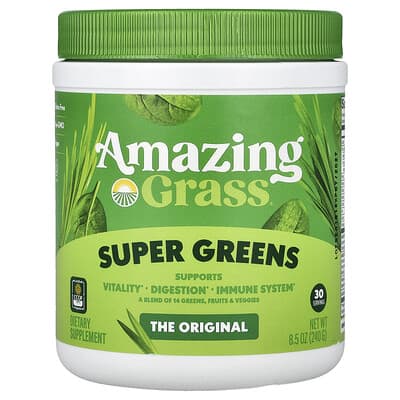
Amazing Grass, Super Greens
Not a "probiotic product" first — it's a daily greens blend that includes a spore-forming strain, Bacillus subtilis DE111, at 1 billion CFU. The spore form is the interesting part: it's built to survive stomach acid and is shelf-stable, which neatly answers the "acid gauntlet" problem from section 02. A nice synbiotic-ish habit for someone who wants greens, antioxidants, and a gentle probiotic nudge in one scoop.
Best for: smoothie people who want a greens + probiotic two-in-one and value acid-resistant spores; not a substitute for a high-CFU targeted strain when you have a specific clinical goal.
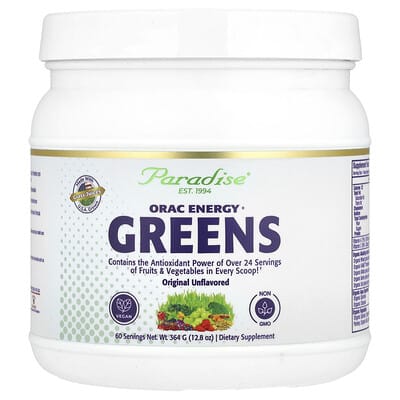
Paradise Herbs, ORAC Energy® Greens
The kitchen-sink option, in a good way: a Lactobacillus/Bifidobacterium probiotic blend paired with inulin/fiber prebiotics (a true synbiotic move), on top of spirulina, chlorella, antioxidant teas, and adaptogenic mushroom botanicals. It's the most "complete daily greens-and-gut" formula of the three — and priced like one. Best for someone who wants a single scoop to cover several bases at once.
Best for: people who want an all-in-one antioxidant + greens + synbiotic ritual and don't mind paying for breadth; skip if you'd rather target one strain precisely or keep the ingredient list minimal.
08The gut–brain axis: your gut talks to your mood
We can't talk about the gut in 2026 without naming the connection that's reshaped how we think about both digestion and mental health: the gut–brain axis. Your gut and your brain are in constant two-way conversation, via the vagus nerve, immune signaling, and — crucially — the molecules your gut microbes produce. A meaningful share of the body's serotonin is made in the gut, and the microbes help regulate the production of neurotransmitter precursors and short-chain fatty acids that influence mood, stress response, and even sleep.
This is why "fix your gut" shows up in every mood, stress, and sleep conversation — and it's also why we'd add the honest asterisk: the gut–brain link is real and important, but it is not a license to treat a probiotic as an antidepressant or a sleep aid. The evidence for specific "psychobiotic" strains influencing mood and stress is genuinely emerging and interesting, but it's not yet the slam-dunk that the marketing implies. The smarter read is that a healthy, well-fed gut is one supportive pillar of mental wellbeing — alongside sleep, stress management, movement, and real professional care when it's needed — not a shortcut around them.
Close the loop at night. A caffeine-free wind-down like Yogi Tea Bedtime® (passionflower + chamomile) is a gut-friendly, calming ritual that supports the sleep your microbiome and your mood both depend on. If the overactive mind is the barrier, the INSOMNIAC: The Ultimate Sleep Therapy guide walks through the science of the "insomniac brain" and practical steps to switch it off — useful context for the sleep side of the gut–brain axis.
See the axis in your own data. WHOOP 5.0 tracks sleep stages, HRV, and a daily recovery/stress picture — a window onto the "brain" end of the axis. Watching how a rough week of sleep and high stress shows up in your recovery (and, anecdotally, in your digestion) can be the nudge to protect both at once. Not a treatment — an honest mirror for the lifestyle layer that ties gut and head together.
09Who should pause before taking probiotics
This is the section the cheerleading articles skip, and it's the one that matters most for safety. Probiotics are gentle for the vast majority of people — but they are live organisms, and in a small number of vulnerable situations, introducing them carries a real (if rare) risk of infection. Run this checklist honestly:
- Severely immunocompromised. People on heavy immunosuppression, certain chemotherapies, or with advanced immune disease should only take probiotics under medical supervision — bacteremia and fungemia from probiotic strains, while rare, are documented.
- Critically ill or hospitalized, especially with a central line. A central venous catheter is a recognized risk factor for probiotic-associated infection; many hospitals restrict probiotics in these patients for exactly this reason.
- Short bowel syndrome / compromised gut barrier. Altered anatomy and a leaky barrier can raise the risk of translocation; clinician guidance is essential.
- Certain heart-valve conditions. Some valve disease raises endocarditis concern; check first.
- The yeast exception. Saccharomyces boulardii is a fungus, so it's the right call alongside antibacterial antibiotics — but it's also the one to be most cautious with when fungemia is a risk, and it won't be helped by antifungal medication timing the way bacterial strains are affected by antibiotics.
- Pregnancy, infancy, serious chronic illness. Often fine, sometimes not — the point is to decide with a clinician who knows the case, not from a label.
Support the gut without adding live cultures. If probiotics aren't right for you right now, the gut still has plenty of non-live support: antioxidant and cellular support like NOW Foods NAC with Selenium (a glutathione precursor), the B-vitamin backbone in Life Extension BioActive Complete B-Complex (mucosal and metabolic support), and — when digestion of meals is the bottleneck — NOW Foods Super Enzymes to help break down proteins, fats, and carbs. None of these are probiotics, and that's exactly the point: there's more than one way to be kind to a gut.
10Building a gut routine that lasts
Let's turn all of this into a routine you can actually keep — because a perfect protocol you abandon in a week loses to a simple one you keep for a year. The order of operations matters: build the foundation first, then add the targeted layer.
- Feed the residents first (prebiotics + food). Diverse plants, fermented foods you tolerate (yogurt, kefir, kimchi, sauerkraut — introduced gently), and soluble fiber from oats, chia, psyllium. This is the durable base.
- Match a strain to a goal, if you have one. Antibiotics coming up? LGG or S. boulardii. Daily bloating/IBS? A named Bifidobacterium or L. plantarum 299v. No specific goal? A broad daily blend like LactoBif 30 is a reasonable baseline.
- Take it consistently, with food, stored correctly. Same time daily, with a meal, kept cool and dry, respected through its expiration date.
- Give it a fair trial, then judge by results. Track symptoms for 4–8 weeks. If nothing changes, you're free to stop or switch — your gut's response is the only verdict that counts.
- Support the whole axis. Sleep, stress, movement, hydration — the lifestyle layer that the gut–brain axis runs on. A probiotic can't out-work a chronically stressed, sleepless life.
Build the food base with intention. The Encyclopedia of Power Foods maps 300+ foods to their properties (modern nutrition plus Traditional Chinese Medicine) — a useful lens for choosing gut-supportive, anti-inflammatory, fiber-rich foods to back up whatever probiotic you pick. Use it as inspiration, then filter through your own tolerance and any clinician guidance — especially across flares or sensitivities.
A gentle daily ferment-friendly habit. A small splash of Bragg Organic Apple Cider Vinegar in water or a dressing is a popular, food-first ritual some people find supportive for digestion (the evidence is modest, the ritual is real). Keep it diluted, keep it gentle, and treat it as one small tile in the mosaic — not a treatment.
⚡ A Healthy Gut Runs on a Plate That Adds Up
Probiotics and prebiotics sit on top of a diet, not instead of one. Use our free calculator to set a calorie and macro baseline that supports steady energy and a well-fed microbiome, then layer your fiber, ferments, and (if you choose) your strain on top of a plate that actually nourishes you.
Try Ileany Calorie Calculator Now 🎯The honest bottom line
Probiotics are neither the miracle the marketing promises nor the waste the skeptics claim — they're a real, specific tool that's been buried under a mountain of vague "balance your gut" hype. The whole game changes the moment you read one level deeper than the front label: the strain code is where the evidence lives, the acid journey decides who actually arrives, the CFU only matters in the context of the right strain and a guaranteed-through-expiry count, and the prebiotic side of the family is often the more reliable, cheaper, food-first way to support the ecosystem you already have.
So match the strain to your goal — LGG or S. boulardii around antibiotics, a named Bifidobacterium or L. plantarum for IBS-type discomfort, a broad shelf-stable blend like LactoBif 30 for a simple daily baseline, or a synbiotic greens scoop if you want your vegetables and your microbes in one ritual. Take it consistently, with food, stored right, and judge it by what actually changes for you over a fair trial.
And hold the two honest asterisks all the way through: a probiotic is one supportive pillar of gut and mental health, not a cure and not a shortcut around sleep, stress, and real care; and for the genuinely vulnerable — the immunocompromised, the critically ill, the central-line and short-bowel patients — live cultures deserve medical sign-off, not a checkout-cart decision. Used that way, with eyes open and labels read, probiotics earn their quiet, specific, well-deserved place in the toolkit — which is exactly the kind of modest, precise win that actually lasts.
Frequently asked questions
Do probiotics actually work for gut health?
Sometimes — and the honest answer depends entirely on the strain and the condition. Probiotics have solid evidence for specific uses, such as preventing antibiotic-associated diarrhea (Lactobacillus rhamnosus GG and Saccharomyces boulardii) and easing some IBS symptoms (certain Bifidobacterium and Lactobacillus plantarum strains). They are not a universal gut cure, and benefits do not transfer from one strain to another.
What is the most important thing on a probiotic label?
The full strain name — genus, species, AND strain code (for example Lactobacillus rhamnosus GG, not just "Lactobacillus"). Evidence is strain-specific, so a product that lists only the genus tells you almost nothing. After that, check the guaranteed CFU at expiration (not just at manufacture), the storage instructions, and whether the strains match your goal.
How many CFU do I need?
There's no single magic number because the right dose is strain- and condition-specific. Many everyday products provide 1–30 billion CFU, while some medical-grade multi-strain formulas used for specific conditions provide far more. More CFU is not automatically better; what matters is that the dose matches the strain and the evidence for your goal.
When should I take a probiotic — morning, night, with food or without?
The data is mixed, but a reasonable and common recommendation is to take most probiotics with a meal or just before one, because food buffers stomach acid and improves the chance the organisms survive to the intestine. Follow the specific product's instructions, and consistency (same time daily) matters more than the exact minute. Spore-based and enteric-coated strains are more acid-resistant and more flexible on timing.
What is the difference between prebiotics, probiotics, postbiotics and synbiotics?
Probiotics are the live organisms themselves. Prebiotics are fibers (like inulin, GOS, psyllium) that feed the good bacteria already in you. Postbiotics are the beneficial byproducts those bacteria make (such as short-chain fatty acids) or inactivated bacterial components. A synbiotic is a product that combines a probiotic with a prebiotic designed to support it.
Who should NOT take probiotics?
People who are severely immunocompromised, critically ill, have a central venous catheter, have short bowel syndrome, or have certain heart-valve conditions should use probiotics only under medical supervision, because in rare cases live organisms can cause infection. Saccharomyces boulardii is a yeast, so it's also a concern in fungemia risk and is unaffected by antibacterial antibiotics. Always check with your doctor if you have a serious condition.
References & further reading
- WHO/FAO — definition and guidelines for the evaluation of probiotics in food; the strain-specificity principle.
- Cochrane Database of Systematic Reviews — probiotics for the prevention of antibiotic-associated diarrhea and for pediatric conditions.
- Strain-specific evidence reviews: Lactobacillus rhamnosus GG; Saccharomyces boulardii CNCM I-745; Bifidobacterium longum/infantis; Lactobacillus plantarum 299v.
- AGA and ACG guidance on the role of probiotics in IBS, IBD, and pouchitis (including high-dose multi-strain formulations).
- Survival of probiotics through gastric acid and bile: effect of food, enteric coating, and spore-forming strains.
- CFU dosing and label-guarantee (at expiration vs at manufacture) — quality and standards literature (ISAPP, GOED-adjacent standards).
- ISAPP consensus statements on prebiotics, postbiotics, and synbiotics — definitions and scope.
- Gut–brain axis reviews: vagal, immune, and microbial-metabolite signaling; the "psychobiotic" concept and its current evidence limits.
- Safety reviews: probiotic-associated bacteremia/fungemia, risk groups (immunocompromised, central lines, short bowel, valve disease).
- Fermented foods and the microbiome: dietary diversity, prebiotic fibers, and tolerability cautions in IBD/strictures.
Comments
Post a Comment