
The Science-Backed Creatine Monohydrate Guide for Muscle & Brain Power
One cheap white powder. Two organs that run on the same fuel system. Decades of muscle evidence, a fast-growing brain story, and a shelf full of overpriced forms you don't need. Here's the honest map.
Creatine isn't a muscle powder that happens to exist. It's a fuel-recycling molecule — and your brain is just as hungry for it as your biceps.
📋 What's inside
- What creatine actually is (and the ATP trick)
- The muscle story — the evidence that's rock solid
- The brain story — the 2026 angle worth knowing
- Monohydrate vs. the fancy forms
- Dosing: load or not, timing, and the water rule
- Who benefits most (it's not just gym rats)
- Myths vs. facts — the honest takedown
- The reviews: four real creatine products
- Stacking, safety & the fine print
- FAQ
If supplements had a hall of fame, creatine monohydrate would be in it with the plaque already polished. It's the single most researched performance supplement on earth, it's cheap, it's safe for the vast majority of people, and — here's the part the gym-bro marketing buried under mountains of "get jacked" hype — it's not just a muscle supplement anymore. The same molecule that helps your muscles recycle energy turns out to do meaningful work for your brain, your memory, and your ability to think clearly when you're tired.
And yet the shelf is a mess. Walk into any store and you'll find creatine in a dozen "advanced" forms — HCL, buffered, nitrate, liquid, "micronized ultra-pure explosion" — each promising better absorption, less bloating, more gains, at three times the price. Almost none of that is true. The boring, cheap, white monohydrate powder is still the king, and the science says so plainly.
This guide is the honest map. We'll explain the one biochemical trick that makes creatine work (and why that same trick powers your brain), walk through the muscle evidence that's genuinely rock-solid, then spend real time on the brain story that's reshaping how we think about this supplement in 2026. We'll settle monohydrate-vs-the-rest, give you the exact dose and the loading-vs-not decision, take down the myths one by one with the actual nuance, show you who benefits most (spoiler: vegetarians and the sleep-deprived have a lot to gain), and review four real products from our tested list — including one built specifically for the cognitive angle.
01What creatine actually is (and the ATP trick)
To understand why creatine works — and why it works in both muscle and brain — you need one piece of biology, and it's genuinely elegant. Your cells run on a molecule called ATP (adenosine triphosphate). Think of ATP as a fully charged battery. Every time a muscle contracts or a neuron fires, it spends a little ATP, snapping off one phosphate and turning it into ADP — a half-dead battery.
The problem is that your cells can't make fresh ATP fast enough to keep up with sudden, intense demand — a heavy lift, a sprint, a hard bout of thinking. So they keep a backup generator on hand: phosphocreatine (PCr). When ATP runs low, an enzyme called creatine kinase grabs a phosphate off phosphocreatine and slaps it onto ADP, instantly recharging it back into ATP. Creatine is the raw material that keeps that backup generator stocked.
This system only lasts about 10 seconds at full tilt — which is exactly why creatine shines in short, intense efforts (and rapid, demanding thought), not in a slow jog.
Now here's the key insight: your body makes some creatine on its own (in the liver and kidneys), and you get some from meat and fish. But your muscles — and your brain — can store more than you typically keep on hand. Supplementing with creatine monohydrate raises those stored levels toward their ceiling, which means a bigger, faster backup generator. More phosphocreatine on tap means you can recharge ATP a little faster and a little longer during the efforts that depend on it.
That single mechanism explains everything that follows: why it helps a heavy set of squats, why it helps a repeated sprint, and — crucially — why it can help a brain working hard on a tough cognitive task, because neurons spend ATP furiously and keep their own phosphocreatine reserve for exactly the same reason muscles do.
02The muscle story — the evidence that's rock solid
Let's start where the evidence is unimpeachable, because it sets the bar for how we'll treat the brain story next. For muscle and performance, creatine monohydrate isn't "probably works" — it's one of the most consistently effective ergogenic aids ever studied, across hundreds of trials and dozens of meta-analyses, and it's endorsed by the International Society of Sports Nutrition as safe and effective.
What it reliably does, when paired with training:
- More strength and power. Typical gains in maximal strength and power output land in the 5–15% range over training with creatine versus training without — a real, measurable edge, especially on repeated high-intensity efforts.
- More work per session. Because you can recharge ATP a touch faster, you squeeze out extra reps or sprints, and that extra volume is what drives adaptation over weeks.
- More lean mass. Part of the early weight is water drawn into muscle cells (a good, hydrating, anabolic signal — not "fake" weight), and part, over time, is genuine muscle from the extra training capacity.
- Better recovery between bouts. The repeated-benefit is the point: creatine shines when you do hard thing, rest briefly, do hard thing again.
It's also worth naming who it helps in the gym beyond the obvious: older adults training to preserve muscle and function (sarcopenia is a real threat, and creatine plus resistance training is a well-supported combo), and women, who were historically under-studied but benefit too, including some evidence for support across the menstrual cycle and post-menopause. The "creatine is for young male bodybuilders" frame is about a decade out of date.
03The brain story — the 2026 angle worth knowing
Now the part that's genuinely shifting the conversation. Your brain is about 2% of your body weight but burns roughly 20% of your energy, and it keeps its own phosphocreatine reserve for the same reason your muscles do — to buffer ATP during sudden, intense demand. A hard bout of thinking, a stressful task, a sleepless night — these drain the brain's energy budget, and creatine is the molecule that tops it back up.
The pattern is the most honest part: the cognitive benefit tends to be largest where the brain's creatine tank starts low or gets drained — not in an already well-rested, meat-eating 20-year-old.
So what does the evidence actually show? Studies have found creatine supplementation can improve short-term memory and reasoning, reduce mental fatigue during demanding or prolonged cognitive tasks, and — strikingly — partly offset the cognitive slump that comes with sleep deprivation. The effects are most consistent and most pronounced in vegetarians and vegans, who get little to no creatine from diet and therefore start with lower brain (and muscle) stores; in them, supplementing is like filling a tank that's been running on reserve.
There's also emerging, more preliminary work in mood, in older adults facing age-related cognitive decline, and even exploratory interest in concussion and traumatic brain injury recovery (the brain's energy crisis after a hit is exactly the kind of situation phosphocreatine could theoretically buffer). We're flagging that last one as early and not settled — promising, not proven.
There's a product built for exactly this brain angle. California Gold Nutrition Creatine Cognitive Formula™ pairs 3 g of creatine monohydrate with L-leucine, blueberry polyphenols, coconut-water electrolytes, and grape extract — a blend aimed at the cellular-energy-meets-cognition intersection rather than pure gym output. We review it properly in section 08; here it's a sign of where the category is heading: creatine as a brain-and-body fuel, not just a muscle powder.
04Monohydrate vs. the fancy forms
This is where the marketing has done the most damage, so let's be blunt: for almost everyone, plain creatine monohydrate is the best choice. It is the form used in the overwhelming majority of the research, it is reliably absorbed, it is the cheapest per effective dose, and the "advanced" alternatives have not beaten it in head-to-head outcomes.
| Form | The pitch | The honest verdict |
|---|---|---|
| Monohydrate | The original | The king. Most-studied, effective, cheap. The default you should buy. "Micronized" just means finer powder that mixes better — same molecule, nicer texture. |
| Creapure® | Branded purity | A high-purity source of monohydrate, not a different form. Worth it if you want guaranteed purity/testing; not required for efficacy. |
| Creatine HCL | "More soluble, less bloating, smaller dose" | More soluble in water, yes; meaningfully more effective in humans, not shown. The smaller dose claim rests on solubility, not on better results. |
| Buffered (Kre-Alkalyn) | "Survives stomach acid better" | Monohydrate already survives fine; trials haven't shown buffered forms to outperform it. Paying extra buys a solution to a non-problem. |
| Liquid / effervescent | "Pre-dissolved = faster" | Creatine can degrade in liquid over time; powder you mix fresh is generally the safer, cheaper bet. |
| Creatine nitrate / other stacks | "Bonus effects" | Often a smaller creatine dose bundled with something else (nitrate, etc.). You may get less actual creatine per scoop than you think — read the label. |
05Dosing: load or not, timing, and the water rule
The good news is that creatine dosing is genuinely simple, and most of the "rules" you'll hear are overcomplicated. Here's the clean version.
Loading is a shortcut, not a requirement. Both roads fill the same tank to the top — one just takes a few weeks longer with far less powder per day (and far less tummy upset).
The dose
- Maintenance: 3–5 g of creatine monohydrate per day, every day. This is the number. For most people, 3 g is enough; larger athletes or those with more muscle mass often use 5 g. Some use a size-based rule (~0.03–0.1 g/kg), but 3–5 g covers the vast majority.
- Loading (optional): ~20 g/day split into 4 doses of 5 g, for 5–7 days, then drop to 3–5 g/day. This saturates stores in about a week instead of three to four. The only real advantage is speed; the downside is some people get stomach upset on the big doses.
- Our honest take: unless you have a specific reason to be saturated this week (a competition, a photoshoot, a fast-approaching event), skip the load. The slow route is gentler on the gut and gets you to the exact same place.
The timing
Here's the liberating truth: timing matters far less than consistency. Creatine works by saturation — by keeping your stores topped up day after day — not by an acute hit right before a set. So the single most important rule is to take it every day, including rest days, at whatever time you'll actually remember.
If you want to squeeze out a small edge, some evidence suggests taking it close to your workout (post-workout may have a slight edge over pre), and taking it with a meal or some carbohydrate and protein can marginally improve uptake (insulin helps shuttle it into muscle). But these are fine-tuning, not fundamentals. A scoop in your post-workout shake, or with lunch, or with your morning coffee — all fine, as long as it's daily.
The water rule
Creatine pulls water into your muscle cells (that's part of how it works, and it's a good thing). So drink enough water. You don't need to drown yourself, but if you're supplementing creatine, being mildly dehydrated is a bad combo — it's behind most of the "cramping" complaints, which usually trace to low fluid and electrolytes, not to the creatine itself. Pair it with a normal, well-hydrated day and the issue largely disappears.
06Who benefits most (it's not just gym rats)
One of the nicest things about creatine is that the people with the most to gain are often not the ones the marketing talks to. Because the benefit tracks with how much room there is to fill the tank, the biggest responses tend to show up in people whose stores start lower or whose demand spikes. Here's the honest, asymmetric picture:
Vegetarians & vegans
Creatine comes mainly from meat and fish, so plant-based diets leave muscle and brain stores notably lower. Supplementing often produces the largest gains — both physical and cognitive — in this group.
Older adults
A double win: helps preserve muscle and strength against sarcopenia when paired with resistance training, plus emerging cognitive support.
The sleep-deprived
Studies suggest creatine can partly buffer the cognitive hit of poor sleep and demanding mental work — relevant to almost everyone in 2026.
Strength & power athletes
The classic, rock-solid case: more reps, more power, more lean mass over time when combined with training.
High cognitive load / students
Demanding mental work drains the brain's energy budget; the cognitive-fatigue evidence is most relevant here, especially with low dietary intake.
07Myths vs. facts — the honest takedown
Creatine carries more folklore than almost any supplement, and most of it is wrong or badly outdated. Here's the takedown, with the nuance that the lazy versions leave out.
"Creatine damages your kidneys."
In healthy people at standard doses, long-term use has been repeatedly shown to be safe, including for kidney function. The fear mostly comes from creatinine (a harmless byproduct) rising on blood tests — which can look like a kidney flag but usually isn't. Pre-existing kidney disease is the real exception — talk to your doctor first.
"It causes baldness."
This traces to a single old rugby study that saw a DHT bump and was never replicated into actual hair-loss evidence. The link is, at best, unproven and likely overstated. If you're genetically prone and anxious about it, it's a personal risk-tolerance call — but the evidence does not support "creatine makes you go bald."
"It's just water weight / it's fake muscle."
Yes, some early weight is intracellular water — but that water is inside the muscle cell, where it's a good, anabolic, hydrating signal, not bloating under the skin. And beyond that water, the extra training capacity drives real lean mass over weeks. It's not "fake."
"You must cycle it (on/off)."
Cycling isn't necessary. Your body doesn't "down-regulate" its own production in a way that requires breaks, and long-term continuous use is the norm in the research. Take it daily; stopping just lets stores drift back down over a few weeks.
"It causes cramping and dehydration."
Large studies and reviews have not found increased cramping or dehydration; some even show the opposite. The cramping stories usually trace to people being under-hydrated. Drink water, and this largely evaporates.
"It's only for young men / bodybuilders."
Outdated. Women benefit too (with growing evidence across the menstrual cycle and post-menopause), older adults benefit substantially, and the cognitive angle is relevant to anyone with a demanding mental load. The "gym-bro" frame is a marketing leftover.
08The reviews: four real creatine products
With the framework in place, here are four creatine products from our tested list — framed by who they fit, scored on purity, value, mixability, and (where relevant) the cognitive angle. We lead with the no-nonsense pure-monohydrate pick, because that's the honest default.
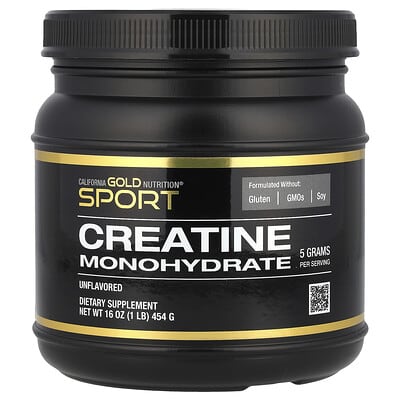
California Gold Nutrition, Sport, Pure Creatine Monohydrate
Exactly what the evidence supports and nothing you don't need: 5 g of micronized creatine monohydrate per scoop, unflavored, no sweeteners or fillers. It dissolves cleanly into water, a shake, or juice, and the price-per-effective-dose is hard to beat. This is the "set it and forget it" tub that matches the science one-to-one.
Best for: almost everyone who wants the proven, no-nonsense monohydrate at a fair price; look elsewhere if you specifically want a flavored ready-to-drink or a cognitive-focused blend.
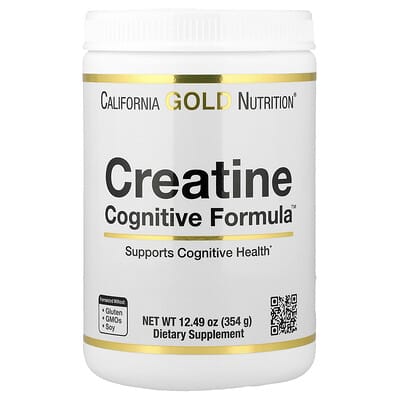
California Gold Nutrition, Creatine Cognitive Formula™
The product that proves the category is moving beyond the gym. It pairs a solid 3 g of monohydrate with L-leucine (muscle protein signaling), antioxidant-rich blueberry and grape polyphenols, and coconut-water electrolytes — a blend aimed at the cellular-energy-meets-cognition space from section 03. Note the creatine dose is 3 g, not 5 g, so it's a cognitive-leaning daily formula rather than a max-muscle loader.
Best for: people drawn to the brain-and-energy angle (students, high cognitive load, plant-based eaters) who want a flavored, all-in-one scoop; pair with a plain monohydrate if you want the full 5 g muscle dose on top.
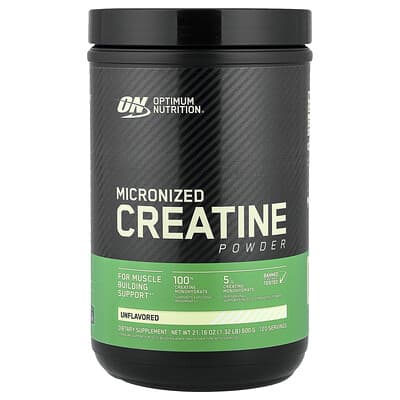
Optimum Nutrition, Micronized Creatine Powder
The micronized monohydrate from one of the most recognized names in sports nutrition — a clean 5 g per serving in a fine, easy-mixing powder. You pay a small premium for the brand and the consistency, and for many people that trust is worth it. Functionally very close to the editor's pick; choose on price and brand preference.
Best for: buyers who want the proven monohydrate from a heritage brand they already trust; skip if pure price-per-gram is your only criterion.
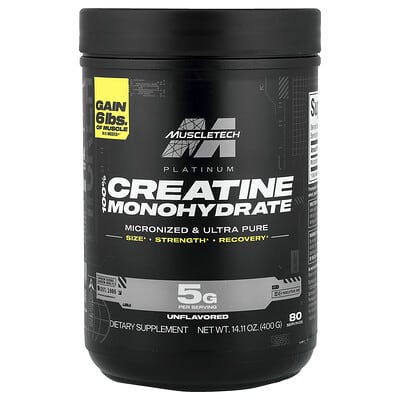
MuscleTech, Platinum 100% Creatine Monohydrate
A no-frills, HPLC-tested micronized monohydrate from a training-focused brand — 5 g of pure creatine per serving, designed to mix into whatever you're already drinking. A solid, reliable workhorse tub that sits comfortably alongside the other pure-monohydrate picks; choose on whichever is best-priced when you buy.
Best for: regular trainees who want a dependable, tested monohydrate at a competitive price and don't need flavor or extras.
09Stacking, safety & the fine print
Creatine plays well with others, and a couple of pairings are genuinely synergistic rather than just "also taking stuff."
- Creatine + protein + carbs. Taking creatine with a meal or a post-workout shake that has protein and carbohydrate may marginally improve uptake (the insulin response helps shuttle it in) — and the protein supports the muscle you're training. A clean whey isolate like California Gold Nutrition Whey Protein Isolate (27 g protein, unflavored) is an easy vehicle to dissolve your monohydrate into.
- Creatine + caffeine. The old worry that caffeine "blunts" creatine is largely overblown and not a practical concern at normal intakes; plenty of people use both without issue. If you're a heavy caffeine user and also sleep-deprived, the bigger lever is fixing the sleep — which is where creatine's brain-buffering role gets interesting.
- Creatine + hydration/electrolytes. The natural partner. Drink enough, and the rare cramp complaint mostly disappears.
Make the daily scoop effortless. Creatine is unflavored and dissolves best with a little agitation — a quick blend into a shake or smoothie beats stirring grit into water. A Nutribullet combo or a Ninja blender turns your creatine + protein + fruit + water into a 30-second habit you'll actually keep — and consistency, remember, is the whole game.
See the training and recovery it supports. Because creatine's value shows up in repeated hard efforts and the recovery between them, it pairs naturally with tracking that work. WHOOP 5.0 logs strain, muscular load, recovery, and sleep — so you can actually watch whether your hard sessions and your recovery are trending the way the supplement is meant to help. Not a treatment; an honest mirror for the effort creatine backs up.
The fine print, plainly
- Expect a small scale bump early. A kilo or two of intracellular water in the first week or two is normal and harmless — it's the muscle hydrating, not fat. Don't panic at the scale; judge by training and how you feel.
- It's not a substitute for training, protein, or sleep. It multiplies effort you put in; it doesn't replace the fundamentals.
- Consistency over timing. Daily beats perfectly-timed. Rest days included.
- Quality matters more than form. Plain monohydrate from a reputable, tested brand is the move; save your money from the fancy forms.
⚡ Creatine Multiplies Effort — Make Sure the Effort Is Fueled
Creatine helps you train harder; the muscle and recovery still depend on eating enough, especially protein and overall calories. Use our free calculator to set a baseline that actually supports the training you're doing, then let creatine amplify the work on top of a plate that adds up.
Try Ileany Calorie Calculator Now 🎯The honest bottom line
Creatine monohydrate is the rare supplement that lives up to — and in some ways exceeds — its reputation. For muscle and performance, the evidence is exceptional and settled: paired with training, it reliably adds strength, power, work capacity, and lean mass, and it's safe and cheap. For the brain, the story is newer and more modest but genuinely real and growing — a meaningful support for memory and mental fatigue, especially in vegetarians, older adults, and the sleep-deprived, because the brain runs on the same phosphocreatine fuel system your muscles do.
And the practical message is refreshingly simple: buy plain, micronized monohydrate (the Cognitive Formula if the brain angle is your thing), take 3–5 g every day, skip the loading unless you have a reason to rush, don't stress the timing, drink your water, and ignore the expensive "advanced" forms and the recycled myths about kidneys, hair, and cramping that the evidence doesn't support.
That's it. One boring white powder, taken consistently, backing up real effort in the gym and real demands in the head — for the price of a few coffees a month. In a supplement world full of noise and markup, that quiet, well-earned reliability is exactly why creatine monohydrate sits at the top of the list. Used with eyes open and the fine print respected, it's one of the few "yes, this one's worth it" answers we get to give.
Frequently asked questions
Does creatine monohydrate actually work?
Yes — for muscle and performance, the evidence is among the strongest of any supplement, with decades of research and position stands (including the International Society of Sports Nutrition) supporting it for strength, power, and lean mass during training. The cognitive evidence is newer and more modest but genuinely promising, especially in vegetarians, older adults, and the sleep-deprived.
How much creatine should I take per day?
The standard maintenance dose is 3–5 g of creatine monohydrate per day, every day. You can optionally "load" with about 20 g per day (split into 4 doses) for 5–7 days to saturate stores faster, but loading is not required — skipping it simply means full saturation takes around 3–4 weeks instead of one.
Does creatine help the brain and cognition?
The brain uses a lot of energy and stores creatine, and the evidence for cognitive benefit is emerging and encouraging — particularly for memory and mental fatigue in vegetarians and vegans, in older adults, and during sleep deprivation or demanding mental tasks. It is not a smart-drug miracle, but a real, modest support for the brain's energy budget.
Is creatine monohydrate better than other forms like HCL or buffered creatine?
For almost everyone, plain creatine monohydrate is the best choice: it is the most studied, the cheapest per effective dose, and reliably effective. Fancy forms (HCL, buffered, liquid, nitrate) cost more and have not been shown to be meaningfully better in head-to-head outcomes. Look for monohydrate, ideally micronized and/or Creapure-grade.
Is creatine safe for the kidneys?
In healthy people, long-term creatine supplementation at standard doses has been repeatedly shown to be safe, including for the kidneys. The common fear comes largely from creatinine (a harmless byproduct) rising on blood tests, which can look like a kidney signal but usually is not. People with pre-existing kidney disease should consult their doctor before using it.
When is the best time to take creatine?
Timing matters far less than consistency — taking it daily is what saturates your stores. If you want to optimize slightly, some evidence suggests taking it close to your workout, ideally with a meal or some carbohydrate and protein. But the simplest reliable rule is: take your 3–5 g at whatever time you will remember every single day.
References & further reading
- International Society of Sports Nutrition (ISSN) — position stand on creatine supplementation and exercise (safety, efficacy, dosing).
- Kreider RB, et al. — International Society of Sports Nutrition position stand: safety and efficacy of creatine supplementation in exercise, sport, and medicine.
- Meta-analyses on creatine and strength / power / lean mass with resistance training.
- Rae C, et al. — oral creatine monohydrate supplementation and cognitive performance (vegetarian / vegan populations).
- McMorris T, et al. — creatine supplementation, sleep deprivation, and cognitive / psychomotor performance.
- Reviews on creatine and cognition in older adults and aging brain energy metabolism.
- Comparative studies: creatine monohydrate vs HCL / buffered / alternative forms (bioavailability and outcomes).
- Loading vs non-loading saturation kinetics of muscle creatine stores.
- Creatine and kidney function / creatinine interpretation — safety reviews in healthy populations.
- Creatine timing and co-ingestion with carbohydrate / protein — uptake studies.
Comments
Post a Comment