
Intermittent Fasting 16/8 for Insulin Sensitivity — The Honest Protocol
16 hours off, 8 hours on. It sounds almost too simple to work — and the truth is more nuanced than the hype. Here's the real mechanism, what the evidence actually supports, who should skip it entirely, and the exact protocol to start without feeling wrecked.
📋 What's inside
- What 16/8 actually is (and what it isn't)
- The mechanism: what fasting does to insulin
- What the evidence really shows — the honest read
- Who should fast, and who really shouldn't
- The gradual start protocol (stop feeling wrecked)
- What to eat in your eating window
- Hydration & electrolytes during the fast
- Training around the fast
- Tracking: how to know it's working
- The mistakes that quietly kill your results
- FAQ
There's a version of intermittent fasting you've seen online that sounds like a religion: fast longer, suffer more, unlock some mystical metabolic state, repeat forever. Then there's the version that actually has science behind it — and it's quieter, more flexible, and far more honest than the cult version.
The 16/8 protocol is the most popular flavor of intermittent fasting for a reason: it's simple, it fits a normal day, and for a lot of people it genuinely helps with insulin sensitivity and weight. But "popular" and "magic" are not the same word, and the gap between them is where people either get great results or quietly give up feeling hungry, dizzy, and disappointed.
This guide is the honest middle. We'll walk through what 16/8 actually does to your insulin, what the trials do and don't support, the people who should not be fasting at all (this part matters more than the protocol itself), and a gradual way to start that doesn't make the first week feel like punishment. Then we'll talk about the part almost everyone gets wrong: what you eat inside your eating window matters just as much as the fast. A fast is a tool. What you do with the rest of the day is what decides whether the tool helps you.
01What 16/8 actually is (and what it isn't)
At its simplest, 16/8 means you eat all your food inside an 8-hour window and take in no calories for the other 16 hours. The most common setup is skipping breakfast and eating from noon to 8 pm, but the clock is yours — if you'd rather eat 9 am to 5 pm and skip dinner, that's a perfectly valid 16/8. The body doesn't read the clock on the wall; it reads the gap between your last bite and your first.
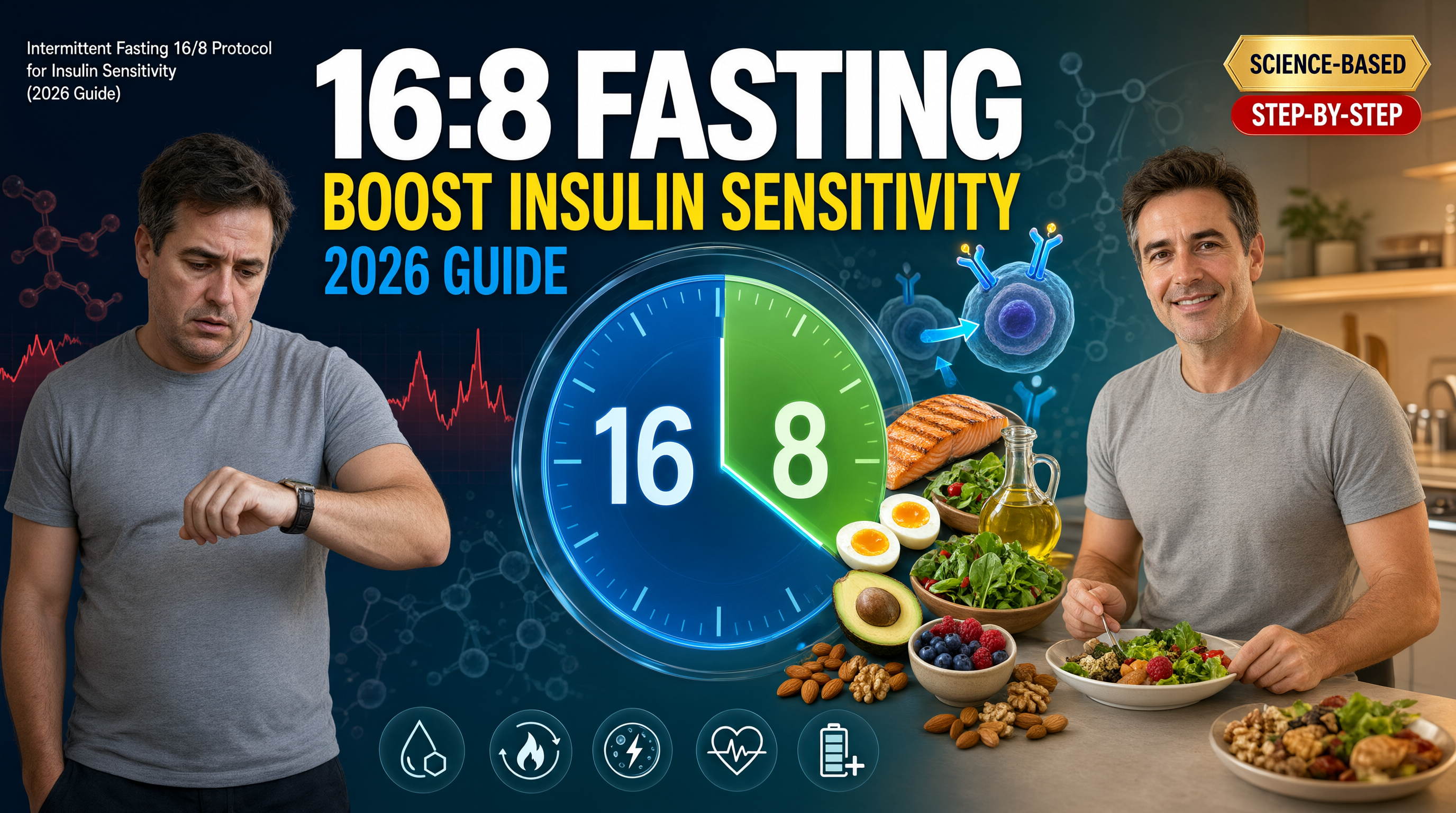
The whole idea in one picture: compress your eating into 8 hours, give your body 16 hours with insulin low, and keep the rhythm consistent.
What it is not is a diet in the usual sense. It doesn't tell you what to eat — it tells you when. That's both its strength and its trap. The strength is simplicity: fewer decisions, a natural tendency to eat a little less, and a long daily stretch where your insulin can drop. The trap is assuming the timing does the work for you while you eat whatever you want in the window. It doesn't. We'll come back to that, because it's the single biggest reason 16/8 "fails" for people.
It's also worth separating 16/8 from the more extreme versions you see online — 20-hour fasts, one-meal-a-day, multi-day fasts. Those are different tools with different risk profiles and a thinner evidence base. This guide sticks to 16/8 because it's the version with the best balance of benefit, safety, and sustainability for most people.
02The mechanism: what fasting does to insulin
Here's the part that makes 16/8 more than a calorie trick — though, to be fair, the calorie part is doing real work too. Let's look at what happens to insulin across a day, because the contrast is the whole point.
Every time you eat, insulin rises to handle the glucose. Graze all day and it never gets a chance to drop. Compress eating, and you create a long daily window where insulin is low.
When you eat, your blood glucose rises and your pancreas releases insulin to move that glucose into your cells. Insulin is also a "storage" hormone — while it's high, your body is in store-energy mode, and fat-burning is largely switched off. If you eat every couple of hours from waking to bedtime, insulin is elevated for most of your waking day, and your cells are constantly being asked to respond to it. Over time, that constant demand is part of what dulls their response — insulin resistance.
Now compress your eating into 8 hours. For the other 16, with no incoming food, insulin falls toward its baseline and stays low. In that low-insulin state a few useful things happen: your body shifts toward burning stored fat for fuel, your liver gets a break from constant glucose handling, and — the part most relevant to this article — your cells get a long stretch without being hammered by insulin, which over time can help them re-sensitize to it.
The well-supported story is the fuel shift and the low-insulin stretch. The flashy "cellular clean-up" claims are far less settled in humans than the marketing suggests.
There's a fourth thing you'll hear a lot about — autophagy, the idea that a long fast flips a cellular "clean-up" switch. It's a real biological process, and it's genuinely interesting in animal and cell studies. But here's the honest footnote: in humans, exactly when it turns on, how strong it is, and whether a 16-hour fast meaningfully triggers it is still uncertain. So enjoy the well-supported benefits — the insulin drop, the fat-burning shift, the simpler eating pattern — and treat the dramatic autophagy claims as "promising, not proven." Don't push a fast longer than feels good chasing a benefit nobody has cleanly demonstrated in people.
03What the evidence really shows — the honest read
Let's grade this the way we grade everything: by what the trials actually support, not by what the headlines promise. The picture for 16/8 and insulin sensitivity is genuinely encouraging — with one big asterisk.
Studies on time-restricted eating (the technical name for 16/8-style fasting) in people with overweight, insulin resistance, or pre-diabetes have repeatedly shown reductions in fasting insulin and improvements in HOMA-IR (a common measure of insulin resistance), along with modest weight and waist-loss. Some trials also show small improvements in blood pressure and triglycerides. So the direction of the effect is real and consistent.
Now the asterisk, and it's an important one: a lot of the benefit tracks with eating less and losing weight. When you close the kitchen for 16 hours, most people naturally eat a little less overall, and weight loss on its own improves insulin sensitivity. When trials carefully match calories between a fasting group and a non-fasting group, the extra benefit of the timing alone is often smaller — sometimes modest, sometimes hard to detect. That doesn't mean 16/8 doesn't work; it means it works largely because it's an easy, low-friction way to eat a bit less and stop grazing, plus it gives insulin a daily rest.
There's also a real, separate benefit that has nothing to do with calories: consistency. A fixed eating window regularizes your meal timing, and regular meal timing is itself good for metabolic health and circadian rhythm. So even before any deep metabolic magic, 16/8 tidies up a chaotic eating pattern — and for a lot of people, that tidying is where the real win lives.
04Who should fast, and who really shouldn't
This is the section most fasting content glides past, and it's the one that matters most for safety. 16/8 is genuinely fine — even helpful — for many people. But for some, it's the wrong tool, and a few groups should not be doing it at all without a doctor in the loop.
Often a good fit
Generally healthy adults, people with overweight or insulin resistance who want a simple structure, those who naturally aren't hungry in the morning, and people who tend to snack late at night and want a clean cut-off. If you feel good fasting and your numbers improve, it's a reasonable tool to keep.
structure seekersTalk to a doctor first
Anyone on insulin or a sulfonylurea (fasting can cause dangerous low blood sugar), people on blood-pressure medication, anyone with kidney disease, and anyone with a medical condition that affects blood sugar. Fasting changes how your medications behave — adjust only with your clinician.
medication usersUsually avoid
Pregnant or breastfeeding women, children and teens, people who are underweight or under-fueled, and anyone with a current or past eating disorder — fasting can be a trigger or a relapse risk. The risk-benefit simply doesn't favor fasting here.
skip itStop if you feel unwell
Dizziness, fainting, severe headaches that don't ease, palpitations, or feeling genuinely unwell are signals to break the fast and eat. A protocol that makes you feel worse is not working, no matter what the clock says. Listen to your body over the timer.
body over clock05The gradual start protocol (stop feeling wrecked)
The number-one reason people quit 16/8 in week one is that they jump straight from a 10-hour overnight gap to 16 hours and spend the first week hungry, irritable, and headachy. Don't do that. Build up. Your body adapts beautifully to a slow ramp; it rebels against a cliff.
A slow ramp turns a miserable first week into a barely-noticeable transition. There's no prize for rushing.
- Find your current gap. Note when you naturally finish dinner and when you first eat. If that's 11 hours, that's your week-one target — don't shrink it yet, just make it consistent.
- Push the first meal, not the last dinner. It's usually easier to delay breakfast than to stop eating at 5 pm. Move your first meal 30–60 minutes later every 3–4 days.
- Park at any step that feels hard. If 14 hours feels rough, stay there a week or two until it's effortless, then push again. There's no deadline.
- Keep the window consistent. Same opening and closing most days. Your body and your hunger hormones settle into a rhythm, and the hunger pangs quiet down.
- Hydrate through the fast. Most early "hunger" is actually thirst or low electrolytes. Water, plus a pinch of salt if you get headaches, changes everything. (More on this next.)
- Make the last meal count. A dinner with real protein, fiber, and fat keeps you satisfied through the morning. A light, carb-heavy dinner leaves you hungry at 7 am.
06What to eat in your eating window
Here's the part that decides whether 16/8 helps your insulin or quietly sabotages it. The fast gets all the credit, but the eating window is where the result is actually built. The biggest mistake in fasting is treating the window as a free pass — eating more, or eating worse, because "I fasted." If your window is a sugar-and-snack free-for-all, you've canceled out the low-insulin stretch you worked for.
 Eat well A 15-minute air-fryer meal beats the fast-food grab when the window opens hungry.
The fix is simple and familiar: build each meal in the window around protein, fiber, and healthy fats, and keep refined sugar and ultra-processed food low. Protein and fiber blunt the glucose spike and keep you full into the fast; healthy fats slow absorption and carry fat-soluble nutrients. This is the same plate logic that helps insulin sensitivity whether you fast or not — fasting just stacks on top of it.
Protein at every meal
Aim for a palm-sized portion of protein each time you eat — eggs, fish, chicken, Greek yogurt, tofu, legumes. Protein blunts the glucose spike, preserves muscle (important when you're eating less), and keeps you satisfied into the fast so you're not white-knuckling the last hour.
spike + satietyFiber fills half the plate
Non-starchy vegetables and fiber-rich foods slow glucose absorption and feed your gut. Fill half the plate with them. A spoon of psyllium husk with water before a meal is a simple extra brake on the spike, if you tolerate fiber well.
slow the spikeHealthy fats to finish
Olive oil, avocado, nuts, and fatty fish slow absorption and keep you full. They also carry fat-soluble vitamins. A drizzle of olive oil or a few nuts with a meal is the difference between a 2-hour and a 4-hour hold before hunger returns.
stay fullTame the sugar, not the joy
You don't have to be perfect — but a window built on sugar and refined carbs defeats the point. Keep sweets small and at the end of a meal, not as the meal. A square of dark chocolate after dinner beats a candy bar on an empty stomach every time.
quality countsHow you break the fast matters most
The first meal after a long fast is the one your body is most sensitive to, so make it the most thoughtful: lead with protein and fiber, not a bowl of sugar on an empty stomach. A simple, reliable break-fast is eggs or Greek yogurt with berries and nuts, or a protein shake if you're in a hurry — something like whey protein isolate blended with a handful of greens and a spoon of nut butter gives you protein and fat without a glucose rollercoaster. The way you open the window sets the tone for the whole fast that follows.
the most important mealMake the window easy to eat well in. A fasted body reaching for whatever's fastest will grab the wrong thing. Keep the right food ready: an air fryer turns chicken and vegetables into a 15-minute break-fast, and a blender makes a protein-and-greens shake a 60-second fallback. For meal ideas that fit a low-spike window, the low-carb recipes in under 10 minutes and a structured plan like The Ultimate Keto Meal Plan take the guesswork out of the window.
Understand the foods, not just the clock. The Encyclopedia of Power Foods maps 300+ foods to how they affect energy, digestion, and blood sugar — a useful lens for choosing what goes in your window, so the window works for your insulin instead of against it.
07Hydration & electrolytes during the fast
A huge share of the headaches, fatigue, and "I can't do this" feelings in the first week of fasting are not hunger at all — they're dehydration and low electrolytes. When insulin drops, your kidneys let go of more water and sodium, and if you don't replace them you feel lousy. This is fixable, and fixing it is often the difference between sticking with 16/8 and quitting.
 Hydrate Most early "hunger" is thirst. A visible bottle keeps you drinking through the fast.
- Water, generously. Aim to drink steadily through the fast, not chug at the end. A visible 1-gallon bottle on your desk turns "drink more" into a habit you actually keep.
- A pinch of salt. If you get fasting headaches or lightheadedness, a pinch of salt in water (or an electrolyte mix without sugar) often clears it within minutes. This is especially relevant if you eat low-salt or take blood-pressure medication (check with your doctor first).
- Black coffee and unsweetened tea are fine. They keep you fasted and many people find they blunt appetite. If coffee on an empty stomach jitters your stomach, switch to tea or just water.
- Magnesium in the evening. A gentle magnesium glycinate at night supports muscle relaxation, sleep, and the electrolyte picture — and better sleep makes the whole protocol easier to keep.
08Training around the fast
Yes, you can train on 16/8, and many people feel great doing it — especially lighter or steady sessions in a fasted state. The trick is matching the session to the fast and feeding yourself well afterward.
- Light and steady sessions (walking, easy cycling, mobility, yoga) are usually fine fasted and can even feel good once you're adapted.
- Hard or long sessions often feel better toward the end of the fast or just before your window opens, so you can eat protein and carbs soon after. Training hard on an empty stomach when you're not adapted is a fast track to feeling faint.
- Eat protein after training. This is where your post-workout protein (a shake or a real meal) earns its keep — it supports recovery and muscle, which matters for insulin sensitivity long-term.
- Stop if you feel dizzy, faint, or unwell. Fasted training is a tool, not a test of willpower. If your body says no, listen.
09Tracking: how to know it's working
Because the whole point here is insulin sensitivity, it helps to have some way to see whether the protocol is actually moving the needle for you — not just trusting the clock. You don't need fancy gear, but some feedback loop keeps you honest and motivated.
- A simple glucose meter lets you check fasting glucose and the spike after your break-fast meal. Over a couple of weeks you'll see which break-fast meals spike you and which keep you flat — that single insight is worth its weight in gold.
- A continuous glucose monitor (CGM), if you have access to one, makes the pattern obvious in real time — you can literally watch the long low fasted stretch and see how different meals behave. Even non-diabetics use them for this kind of learning, where available.
- A wearable like WHOOP 5.0 won't measure glucose, but it tracks sleep, recovery, HRV, and strain — and since poor sleep and high stress both wreck insulin sensitivity, seeing those improve as your routine settles is a powerful signal that the whole system is moving the right way.
- The low-tech version works too: a weekly waist measurement, a morning energy note, and how your clothes fit. If those trend the right way over a month or two, the protocol is doing its job.
10The mistakes that quietly kill your results
Most people who "fail" at 16/8 aren't failing because fasting doesn't work — they're tripping over one of these. Spot yours and fix it, and the protocol usually starts working.
"I fasted, so I can eat whatever in the window."
The window isn't a free pass. A window full of sugar and snacks cancels the low-insulin stretch you fasted for. Build the window around protein, fiber, and fats — the fast and the food are one protocol, not two.
"I'll start at 16 hours tomorrow."
Cliff-jumping into 16 makes week one miserable and most people quit. Ramp from 12 to 14 to 16 over a few weeks. A slow ramp you keep beats a fast one you abandon.
"My headache means it's working."
Headaches and fatigue in the fast are usually dehydration and low salt, not a sign of success. Drink water, add a pinch of salt, and ease the ramp. Suffering is not the point.
"I'll skip protein to keep calories low."
Under-eating protein while fasting costs you muscle, which hurts insulin sensitivity long-term. Hit protein at every meal in the window; it's the nutrient that protects you most.
"My window can move around every day."
A shifting window keeps your hunger hormones and circadian rhythm guessing. A consistent window, most days, is a big part of why 16/8 works. Pick a window and live in it.
"Longer is always better."
Pushing past 16 for "more autophagy" isn't clearly supported in humans and can backfire — under-fueling, stress, and poor sleep all hurt insulin sensitivity too. The sustainable 16 (or 14) is the one with the evidence.
The honest bottom line
The 16/8 protocol is one of the simplest, most sustainable tools we have for nudging insulin sensitivity in the right direction — and the evidence, read honestly, supports it as a real and useful tool, especially for people with overweight or insulin resistance. The mechanism is straightforward: a long daily stretch with insulin low gives your cells a rest, shifts fuel toward fat, and tidies up a chaotic eating pattern. Much of the benefit comes from the same things that help insulin sensitivity anyway — eating a little less, stopping the grazing, and keeping a consistent rhythm — and that's a feature, not a flaw.
But the protocol lives or dies on two things the clock can't control: what you eat in the window (protein, fiber, and fats, with sugar kept low) and whether it's actually safe and sustainable for you. For many people it's a gentle, effective structure. For others — anyone on insulin or glucose-lowering drugs, pregnant or breastfeeding, with a history of eating disorders, or under-fueled — it's the wrong tool, and that's not a failure, it's just honest.
So start slow, hydrate like it matters (because it does), build the window around real food, and give it a few weeks of consistency before you judge it. Track something — a meter, a wearable, a waist measurement, how you feel — so you're steering by data instead of hope. And the moment it stops being sustainable, adjust it; the version you can keep for a year is the one that changes your numbers.
16 hours off, 8 hours on, done with kindness and a little structure. That's the whole protocol. The rest is just learning your own body well enough to make it yours.
Frequently asked questions
Does 16/8 intermittent fasting improve insulin sensitivity?
Often, yes — but mostly through the same levers that improve insulin sensitivity anyway: lower insulin during the long fast, a tendency to eat fewer calories, and loss of visceral fat. Trials show reductions in fasting insulin and HOMA-IR, but much of the benefit tracks with weight loss and a shorter, more consistent eating window rather than fasting being a magic switch. It's a tool, not a cure.
How do I start 16/8 without feeling miserable?
Start gradually. Push your first meal later by 30 to 60 minutes every few days until you reach 16 hours, or begin at 12 to 14 hours and build up. Keep a consistent eating window, hydrate with water and electrolytes during the fast, eat enough protein and fiber in your window, and stop if you feel unwell. Consistency beats length.
What can I have during the fasting window?
Water, plain sparkling water, black coffee, and unsweetened tea keep you fasted. A pinch of salt or a sugar-free electrolyte mix can help with headaches and fatigue, especially early on. Avoid anything with calories, sugar, or insulin-spiking sweeteners. If your goal is health rather than a strict fast, a small amount of cream or a low-calorie drink is a reasonable personal choice.
Who should NOT do intermittent fasting?
People with type 1 diabetes or type 2 diabetes on insulin or sulfonylureas (risk of dangerous hypoglycemia), pregnant or breastfeeding women, anyone with a history of eating disorders, people who are underweight or under-fueled, children and teens, and anyone who feels unwell when fasting should avoid it or do it only with medical supervision. Always talk to your doctor first if you take glucose-lowering or blood-pressure medication.
What should I eat in my eating window?
Focus on protein at every meal, plenty of non-starchy vegetables and fiber, and healthy fats, while keeping refined sugar and ultra-processed food low. The biggest mistake is using the window to overeat or binge on sugar, which cancels the insulin benefit of the fast. Quality and quantity inside the window matter as much as the fast itself.
Can I exercise while fasting 16/8?
Yes, and many people train fine fasted, especially lighter or steady sessions. For hard or long sessions, train toward the end of the fast or just before your eating window, then eat protein afterward. Listen to your body, stay hydrated, and stop if you feel dizzy or faint.
References & further reading
- Patterson RE, Sears DD — Metabolic effects of intermittent fasting. Annual Review of Nutrition.
- de Cabo R, Mattson MP — Effects of intermittent fasting on health, aging, and disease. New England Journal of Medicine.
- Lowe DA, et al. — Effects of time-restricted eating on weight loss and other metabolic parameters. JAMA Internal Medicine.
- Hutchison AT, et al. — Time-restricted feeding improves insulin sensitivity in men at risk of type 2 diabetes. Obesity.
- Antoni R, et al. — Intermittent fasting and metabolic health: evidence and mechanisms. Proceedings of the Nutrition Society.
- Varady KA, et al. — Clinical application of intermittent fasting for weight loss and metabolic health. Nature Reviews Endocrinology.
- Wilkinson MJ, et al. — Ten-hour time-restricted eating reduces weight, blood pressure, and atherosclerotic lipids. Cell Metabolism.
- American Diabetes Association — Standards of Care: nutrition and lifestyle guidance for insulin resistance and type 2 diabetes.
Comments
Post a Comment