
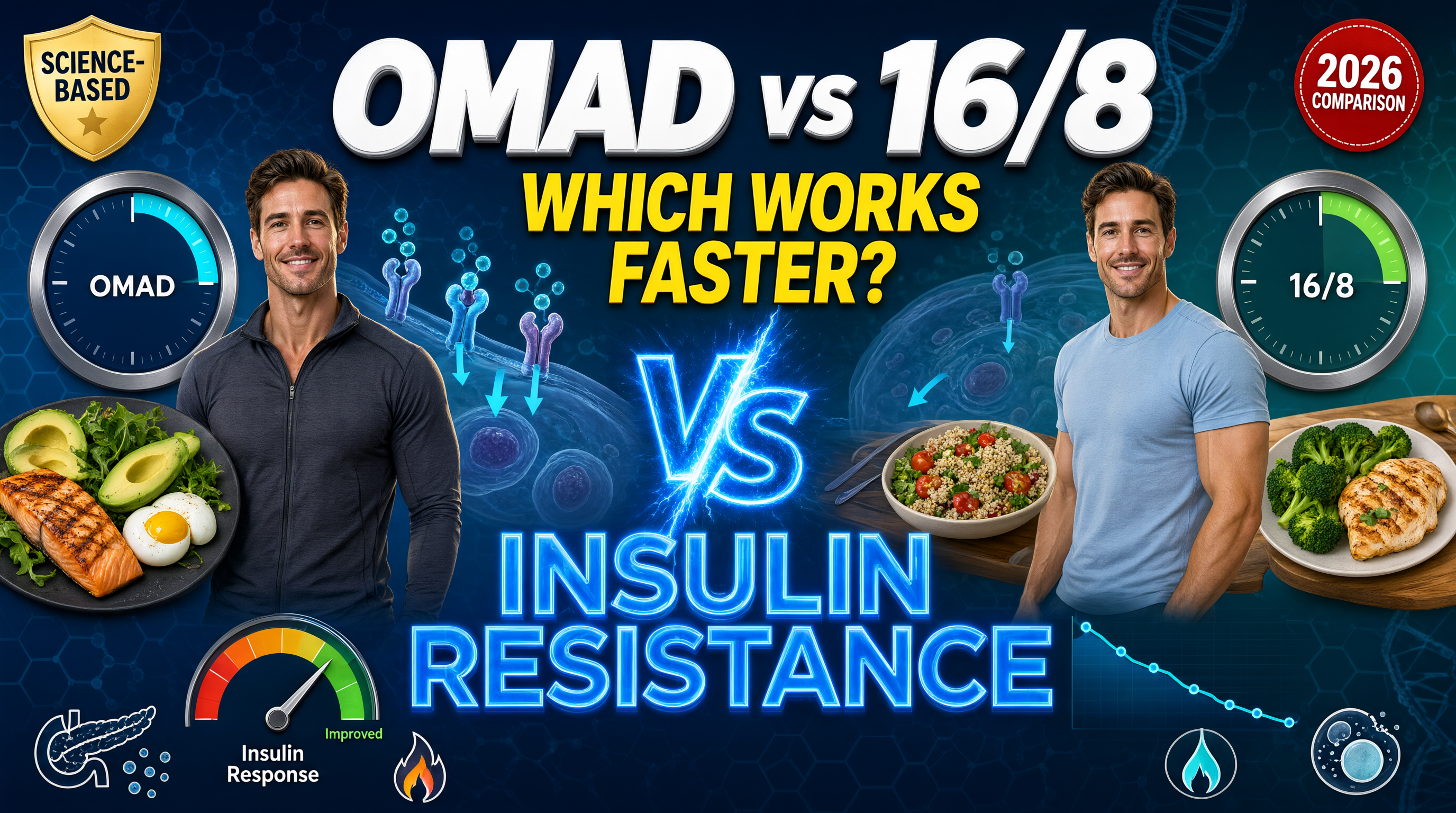
OMAD vs 16/8: Which Fasting Protocol Beats Insulin Resistance Faster?
One meal a day promises the fastest results. Sixteen-eight promises the ones you can keep. We put them head-to-head on the science that actually matters — insulin — and the answer is more surprising than either camp admits.
📋 What's inside
- The two protocols, side by side
- The mechanism: how each one touches insulin
- What the evidence actually says
- The surprise: why "longer" isn't always "better"
- Head-to-head scorecard
- Who each protocol is really for
- How to start each one (without crashing)
- What to eat — the real difference
- The risks & who must skip OMAD
- The verdict
- FAQ
Ask the internet which fasting protocol is "best" for insulin resistance and you'll start a small war. Team OMAD swears that eating one meal a day is the fastest path to flatlined insulin and melted fat. Team 16/8 calls OMAD a miserable, muscle-eating stunt and points to the protocol you can actually live with. Both sides are sure. Both sides are partly right. And the part they're both missing is the most interesting part of the whole debate.
Here's the honest setup: OMAD gives you a much longer daily fast — roughly 23 hours of low insulin against 16/8's 16 — and in pure metabolic theory, longer low-insulin time should mean more fat-burning and more cellular "rest." That's the real argument for OMAD, and it's not nonsense. But theory is not the same as what happens in a human body that has to eat its entire day of food in a single sitting, and that's where the story gets complicated.
This guide refuses to pick a tribe. We'll lay the two protocols side by side, walk through what each one actually does to your insulin, read the evidence without the spin, and confront the surprising reason a longer fast can sometimes produce a worse blood-sugar response than a shorter one. Then we'll give you a clear, honest verdict — not "which is best forever," but "which is faster, which is safer, and which one you'll still be doing in a year." Because the protocol that wins on paper but loses in your kitchen wins nothing at all.
01The two protocols, side by side
Before we argue about which is better, let's be precise about what each one actually is — because the difference is bigger than "skip a meal."
OMAD
Fast for ~23 hours, eat your entire day's calories in a single ~1-hour window. One meal. That's the whole protocol.
- Longest practical daily fast — insulin low almost all day
- Maximum simplicity: one meal to plan
- Hard to eat enough protein & nutrients in one sitting
- One large meal = one large glucose load
- Hunger, social friction & binge risk are real
16/8
Fast for 16 hours, eat within an 8-hour window — typically two or three meals (e.g., noon to 8 pm).
- Solid daily low-insulin stretch
- Room for 2–3 balanced, protein-rich meals
- Fits a normal social & family life
- Far more research behind it
- Shorter fast than OMAD (the trade-off)
The core trade-off in one picture: OMAD maximizes the fasted stretch; 16/8 maximizes the room to eat well. Each choice has a cost.
The simplest way to hold the difference in your head: OMAD maximizes the fast; 16/8 maximizes the meal. OMAD says "give insulin the longest possible vacation." 16/8 says "give insulin a solid daily break, but leave enough room to eat like a well-nourished human." Everything else in this article flows from that single trade-off.
02The mechanism: how each one touches insulin
To compare them fairly on insulin, we need to track two things, not one: how low insulin stays during the fast, and how high it spikes when you finally eat. OMAD wins the first contest hands down. The second contest is where it gets interesting — and where OMAD's advantage starts to leak away.
OMAD's curve is a long flat valley with one sharp mountain. 16/8 is a long valley with a few gentle hills. Which shape is "better" depends on what you're optimizing — and that's the whole debate.
Here's the mechanism in plain terms. During any fast, with no food coming in, insulin drifts down toward baseline and your body shifts toward burning stored fat. OMAD extends that low-insulin valley to ~23 hours — the longest practical daily fast — so on the "time spent with insulin low" metric, it wins decisively. That's the genuine metabolic case for OMAD, and it's why proponents see faster fat loss and, in some people, faster-falling fasting insulin.
But insulin sensitivity isn't only about how low insulin goes — it's also about how gracefully your body handles glucose when you do eat. And here's the catch: a single large meal delivers a whole day's worth of carbohydrate in one bolus. That can produce a steep, tall insulin spike — the "mountain" in the chart. 16/8, by spreading the same food over two or three meals, produces smaller, gentler rises. So the two protocols are genuinely optimizing different things: OMAD maximizes the depth and length of the low-insulin state; 16/8 minimizes the size of each insulin rise.
03What the evidence actually says
Now the part that should humble both tribes: the evidence is not as settled as the loudest voices pretend. Let's grade it honestly.
For 16/8 and time-restricted eating, the evidence base is reasonably solid and growing. Multiple trials in people with overweight, insulin resistance, or pre-diabetes show reductions in fasting insulin and HOMA-IR, modest weight and waist loss, and small improvements in blood pressure and lipids. It's not magic — much of the benefit tracks with eating a little less and losing weight — but the direction is consistent and the studies are real.
For OMAD, the honest truth is that the human evidence is thin. Most OMAD studies are small, short, and sometimes done in lean young subjects rather than people with insulin resistance. And the results are genuinely mixed — which is the part OMAD marketing leaves out.
| Question | OMAD (23:1) | 16/8 |
|---|---|---|
| Length of daily low-insulin stretch | Longest (~23 h) — wins | Solid (16 h) |
| Quality of human evidence | Small, short, mixed | Larger, more consistent |
| Effect on fasting insulin / HOMA-IR | Can improve, but data limited | Consistently modest improvement |
| Post-meal glucose handling | One large meal → risk of a sharp spike | Smaller meals → gentler curves |
| Speed of early results | Often faster (bigger calorie cut) | Steadier |
| Sustainability (real-world) | Hard for most people | Easy for most people |
| Muscle / protein adequacy | Harder to hit protein in one meal | Easier across 2–3 meals |
| Safety margin | Narrower (hypoglycemia, binge risk) | Wider |
Read that table slowly, because it's the whole argument. OMAD wins on the theoretical metric (longest low-insulin stretch) and often on speed of early results. 16/8 wins on quality of evidence, safety, sustainability, and practical nutrition. "Which improves insulin resistance faster" and "which improves it better, safer, and for longer" are two different questions — and they don't have the same answer.
04The surprise: why "longer" isn't always "better"
This is the part neither tribe wants to talk about, and it's the most important idea in the article. There's a quiet assumption in fasting culture that longer fast = better blood sugar. It feels obviously true. And yet the physiology says something more subtle.
Insulin sensitivity is shaped not just by how long insulin stays low, but by how large and sharp each insulin response is when you eat. A 23-hour fast followed by a single enormous meal asks your body to process an entire day's glucose in one go. For many people — especially those who already have insulin resistance — that produces a tall, steep glucose and insulin spike, exactly the kind of exaggerated response that, repeated daily, is part of what worsens insulin resistance in the first place.
In fact, some of the small OMAD studies found precisely this: when people ate all their calories in one meal, their post-meal glucose excursions were larger, even though they were fasting the rest of the day. The fast was long and low, but the single meal was a metabolic event. That's the paradox: you can have the longest fast in the world and still slam your system with a giant spike the moment you eat.
16/8 sidesteps much of this problem by design. Because the window is 8 hours, you naturally spread food across two or three meals, and each one produces a smaller, gentler rise. You sacrifice some fasting length, but you gain smoother glucose curves — and for insulin sensitivity, smooth and sustainable often beats long-and-spiky.
05Head-to-head scorecard
Let's make the comparison concrete. Here's how the two protocols score across the categories that actually matter for someone trying to improve insulin resistance — not just the fastest number on a meter.
Tally it up and the pattern is unmistakable: OMAD wins two categories (speed and low-insulin time), and 16/8 wins the other eight. That's not a coincidence — it's the fundamental shape of the trade-off. OMAD concentrates its benefits into intensity; 16/8 spreads its benefits across everything that makes a health habit actually stick. For a chronic, lifestyle-driven condition like insulin resistance, the categories 16/8 wins are the ones that decide your result a year from now.
06Who each protocol is really for
The honest answer to "which is better" is "better for whom." These two protocols suit genuinely different people, and matching the tool to the person matters more than crowning a universal winner.
OMAD may suit…
Healthy adults who are not on glucose-lowering medication, who aren't hungry in the morning, who want maximum simplicity (one meal to plan), and who can build a single nutrient-dense, protein-rich meal without turning it into a binge. It can also suit experienced fasters who've adapted and feel genuinely good on it. It is a tool for a specific, healthy minority — not a default.
the experienced few16/8 suits almost everyone…
Most people with insulin resistance or pre-diabetes, anyone new to fasting, people who need to eat enough protein (including older adults and those building muscle), anyone with a social or family eating life, and anyone who tried extreme fasting and bounced. It's the default starting point for a reason: effective, gentle, and sustainable.
the smart defaultNeither (without a doctor)…
Anyone on insulin or a sulfonylurea (hypoglycemia risk), people with type 1 diabetes, pregnant or breastfeeding women, anyone with a current or past eating disorder, people who are underweight or under-fueled, children and teens. Fasting changes how medications and metabolism behave — these groups need medical guidance, not a protocol from the internet.
medical guidance firstUndecided? Start here…
If you're not sure, the answer is simple: start with 16/8. It's safer, better studied, and you can always experiment with longer fasts later once you understand how your body and your glucose respond. There is no prize for starting at the hardest setting. Earn the longer fast; don't assume it.
16/8 first07How to start each one (without crashing)
Whichever you choose, the rule is the same: ramp, don't cliff-jump. The people who quit fasting in week one almost always tried to go from a 10-hour overnight gap straight to their target and spent the week hungry, headachy, and irritable. Build up.
Starting 16/8 (the gentle path)
- Begin at 12–14 hours. Push breakfast a little later or dinner a little earlier until you have a comfortable 12–14 hour gap.
- Add 30–60 minutes every few days until you reach 16. Park at any step that feels hard until it's easy.
- Keep the window consistent — same open and close most days. Your hunger hormones settle into the rhythm.
- Hydrate through the fast (water, black coffee, tea; a pinch of salt if you get headaches).
- Land at 14 if that's sustainable. A comfortable 14 you keep beats a miserable 16 you abandon.
Starting OMAD (only if healthy & adapted)
- Master 16/8 first. Don't start here. Get comfortable with time-restricted eating before you compress further.
- Step down gradually: 16/8 → 18/6 → 20/4 → OMAD, over several weeks. Let your body adapt at each step.
- Build the one meal deliberately — protein first, then vegetables and fiber, then healthy fats. This is non-negotiable (next section).
- Watch for red flags: dizziness, faintness, intense binge urges, or feeling unwell mean stop and widen the window.
- Don't do it daily at first. Some people do OMAD a few days a week and 16/8 on others — a hybrid that captures benefits with less risk.
08What to eat — the real difference
This is where the two protocols diverge most in practice, and where OMAD lives or dies. With 16/8, you have room to eat two or three balanced meals — easy to hit your protein, fiber, and nutrients. With OMAD, you have to fit a whole day of nutrition into one meal, and that changes everything about how you must build it.
 Build it right Whether it's one big meal or three, protein + vegetables first is how you protect the fast's benefit.
Eating on 16/8
Spread food over 2–3 meals. Lead each with protein, fill half the plate with vegetables, add healthy fats, and keep refined sugar low. The spread naturally blunts each glucose rise and makes hitting protein and micronutrients easy. This is the forgiving version — there's room to eat well.
room to eat wellEating on OMAD
The one meal must do a whole day's job: a large palm-or-two of protein, a big pile of vegetables and fiber, and healthy fats — with refined carbs and sugar kept low to blunt the spike. Eat protein and vegetables first, carbs last. Rushing a single huge meal of junk is how OMAD backfires on insulin. The meal is the hard part.
the meal is the workHit protein in a single meal (critical for OMAD). Fitting a full day of protein into one sitting is the hardest part of OMAD. A dense, easy option is whey protein isolate (27 g protein per serving) blended in a Nutribullet with greens and nut butter — a nutrient-dense way to reach your protein target without feeling stuffed. On 16/8, the same shake is an easy break-fast that leads with protein instead of sugar.
Blunt the spike with fiber. Whether you're eating one meal or three, soluble fiber slows glucose absorption. A spoon of psyllium husk in water before you eat, and a tablespoon of apple cider vinegar in water, are simple, evidence-touching ways to flatten the post-meal rise — especially valuable on OMAD, where the single meal is the whole glucose event.
Plan meals that protect your insulin. A structured plan removes the guesswork: The Ultimate Keto Meal Plan or the low-carb recipes in under 10 minutes make low-spike meals easy, and The Encyclopedia of Power Foods helps you choose foods that work for your blood sugar.
⚡ Get the Numbers Right First
Both protocols work best when your calories and macros are dialed in — especially protein, which protects muscle and blunts glucose. Use our free calculator to set a baseline, then build your fasting window (or your one meal) around it.
Try Ileany Calorie Calculator Now 🎯09The risks & who must skip OMAD
Let's be blunt about safety, because OMAD's intensity makes this section more important than it is for 16/8. A 23-hour daily fast is a real metabolic stressor, and for the wrong person it can be genuinely dangerous.
Hypoglycemia risk
For anyone on insulin or a sulfonylurea, a 23-hour fast can drive blood sugar dangerously low. This is the single biggest OMAD danger, and it's why people on glucose-lowering medication must not fast this aggressively without medical supervision and dose adjustment.
the big oneThe rebound spike
A single large meal — especially one heavy in refined carbs — can spike glucose and insulin sharply after a long fast. For someone already insulin-resistant, that daily spike can work against the very goal. The meal must be built to blunt it.
build the mealBinge & nutrient gaps
Extreme restriction can trigger binge eating in susceptible people, and cramming a day's nutrition into one meal makes it easy to fall short on protein, fiber, and micronutrients — and to lose muscle over time. Anyone with an eating-disorder history should avoid OMAD.
real downsidesSkip it entirely
Pregnant or breastfeeding women, children and teens, people who are underweight or under-fueled, and anyone with type 1 diabetes should not do OMAD. The risk-benefit doesn't favor it. 16/8 — or no formal fasting at all — is the safer path for these groups.
not worth itSee how your body actually responds. The safest way to choose between protocols is to measure, not guess. A wearable like WHOOP 5.0 tracks sleep, recovery, HRV, and stress — all of which a too-aggressive fast can worsen. If you have access to a glucose meter or CGM, watching your post-meal curves on 16/8 versus a longer fast is the single most informative experiment you can run. Data beats dogma.
10The verdict
So — which protocol improves insulin resistance faster? Here's the honest, nuanced answer, because you deserve better than a bumper sticker.
On raw speed, OMAD has the edge. A ~23-hour daily fast keeps insulin low longer than 16/8, and the larger calorie cut usually means faster early weight loss and faster-falling fasting insulin in the short run. If "faster" is the only word you care about, and you're a healthy person who can build a clean single meal, OMAD can move the needle quickly.
But here's the part that changes the answer: "faster" is the wrong word for a chronic condition. Insulin resistance isn't a two-week sprint you win and walk away from — it's a long-term metabolic pattern that responds to what you can sustain. And on sustainability, safety, quality of evidence, muscle preservation, nutrient adequacy, and real-world livability, 16/8 wins decisively. A protocol that's 80% as intense but that you'll still be doing in a year beats a protocol that's 100% as intense but that you abandon in a month. The tortoise, again, beats the hare.
Speed and sustainability pull in opposite directions. For a chronic condition, the sustainable winner is the real winner.
So here's the bottom line, in one breath: OMAD is probably faster; 16/8 is probably better. If you're healthy, experienced, not on glucose-lowering medication, and you can build a single clean, protein-rich meal without bingeing, OMAD — or a hybrid of mostly-16/8 with occasional longer fasts — is a reasonable way to add intensity. For everyone else, and especially for anyone with insulin resistance, pre-diabetes, or a history of yo-yo dieting, 16/8 is the smarter, safer, better-evidenced choice that you'll still be doing when it matters.
Myths vs. facts
"OMAD is automatically better because the fast is longer."
Longer isn't automatically better. A 23-hour fast followed by one huge meal can produce a sharp glucose spike that works against insulin sensitivity. The whole 24-hour pattern matters, not just the fasting hours.
"16/8 is too easy to work."
"Easy" is a feature, not a bug. 16/8 has a solid evidence base, improves fasting insulin and HOMA-IR, and — crucially — is something most people can sustain. Easy-to-keep beats impressive-to-abandon.
"Fasting longer burns dramatically more fat."
A longer fast does increase fat oxidation during the fast, but total fat loss is driven mostly by your overall calorie balance over time. The extra hours add a modest edge, not a magic multiplier.
"OMAD is fine for anyone with diabetes."
It can be dangerous. People on insulin or sulfonylureas risk severe hypoglycemia during a 23-hour fast, and the single meal can spike glucose. This group needs medical supervision, not internet protocols.
"You can't build muscle on OMAD."
You can, but it's harder — fitting a full day of protein into one meal is difficult, and the body uses protein more efficiently when it's spread across the day. For muscle, 16/8's two-to-three meals have a clear practical edge.
"You must pick one and stick to it forever."
You can flex. Many people do 16/8 most days and an occasional longer fast. The best protocol is the one that fits your life this season — and that can change.
The honest bottom line
OMAD and 16/8 are both legitimate tools, and the tribal war between them misses the point. OMAD wins on speed — its ~23-hour fast keeps insulin low longer and usually drops numbers faster in the short run. That's real, and it's why the protocol has devoted fans. But the human evidence is thin, the single large meal can spike glucose sharply, and the risks (hypoglycemia, binge eating, muscle and nutrient shortfalls) are real.
16/8 wins on everything that decides a long-term result — quality of evidence, safety, glucose smoothness, sustainability, muscle preservation, and the simple fact that most people can actually keep doing it. For a chronic, lifestyle-driven condition like insulin resistance, those are the categories that matter, because the protocol you abandon in a month changes nothing.
So our verdict is nuanced and we won't pretend otherwise: OMAD is probably faster; 16/8 is probably better. Make 16/8 your default. If you're healthy, experienced, and not on glucose-lowering medication, an occasional OMAD day — or a hybrid pattern — can add intensity. But build the meal carefully, track how your body and glucose respond, and never let "faster" talk you into something you can't sustain or that isn't safe for you.
In the end, the winner isn't the protocol with the longest fast. It's the one you're still doing, happily, a year from now. For almost everyone, that's 16/8 — and that's not a consolation prize. That's the whole point.
Frequently asked questions
Does OMAD improve insulin resistance faster than 16/8?
In theory OMAD can move numbers faster because the daily fast is much longer and total calories often drop more. But the human evidence for OMAD is small and short, and some studies show that eating all your calories in one sitting produces a sharp post-meal glucose and insulin spike that can work against insulin sensitivity. For most people, 16/8 delivers comparable metabolic benefits with far better sustainability, safety, and evidence behind it.
Is OMAD safe for insulin resistance or diabetes?
It can be risky. Anyone on insulin or a sulfonylurea faces a real danger of severe hypoglycemia during a 23-hour fast, and a single large meal can spike glucose sharply. People with diabetes, pregnant or breastfeeding women, anyone with a history of eating disorders, and people who are underweight should avoid OMAD or only attempt it under medical supervision. 16/8 is the gentler, better-studied starting point.
Why might a longer fast not be better for blood sugar?
Because the size of the meal matters as much as the length of the fast. Cramming a full day of food into one meal delivers a large glucose load all at once, causing a steep insulin spike. Spreading the same food over two or three meals in an 8-hour window produces smaller, gentler rises. A long fast followed by a huge spike is not automatically better than a shorter fast with smoother curves.
Which fasting protocol is easier to stick with?
16/8, by a wide margin. An 8-hour eating window fits a normal social and family life, makes it easier to eat enough protein and nutrients, and rarely triggers the intense hunger, irritability, or binge risk that a 23-hour fast can. The protocol you can keep for a year beats the protocol that gets the fastest two-week result you then abandon.
Can I build or keep muscle on OMAD?
It's harder. Hitting your daily protein in a single meal is difficult, and the body uses protein for muscle maintenance more efficiently when it's spread across the day. Older adults and anyone prioritizing muscle generally do better distributing protein over two or more meals, which favors 16/8 over OMAD.
What's the best way to decide between OMAD and 16/8?
Start with 16/8 — it's safer, better studied, and sustainable. Track how you feel and, if you can, how your glucose behaves. Only consider OMAD later, gradually, if you're healthy, not on glucose-lowering medication, and you can build a single nutrient-dense, protein-rich meal without bingeing. When in doubt, ask your doctor, especially if you have any metabolic condition.
References & further reading
- St-Onge MP, et al. — Meal frequency and timing: one meal a day vs. multiple meals and metabolic outcomes. American Journal of Clinical Nutrition.
- Hutchison AT, et al. — Time-restricted feeding improves insulin sensitivity in men at risk of type 2 diabetes. Obesity.
- de Cabo R, Mattson MP — Effects of intermittent fasting on health, aging, and disease. New England Journal of Medicine.
- Patterson RE, Sears DD — Metabolic effects of intermittent fasting. Annual Review of Nutrition.
- Varady KA, et al. — Clinical application of intermittent fasting for weight loss and metabolic health. Nature Reviews Endocrinology.
- Lowe DA, et al. — Effects of time-restricted eating on weight loss and other metabolic parameters. JAMA Internal Medicine.
- Wilkinson MJ, et al. — Ten-hour time-restricted eating reduces weight, blood pressure, and atherosclerotic lipids. Cell Metabolism.
- American Diabetes Association — Standards of Care: nutrition, meal timing, and lifestyle guidance for insulin resistance and type 2 diabetes.
Comments
Post a Comment